
What Is an AI Marketing Audit?


And Why It’s the Smartest Place to Start.
When most people hear the word audit, they think of something intimidating. A tax review. A financial inspection. Something designed to catch mistakes.
In reality, audits are one of the most valuable starting points in almost any marketing engagement.
Throughout my career in digital marketing, I’ve conducted audits across nearly every area of the discipline, including paid media performance, social channels, website effectiveness, analytics frameworks, and reporting processes. Sometimes the scope is narrow. Other times it’s broad and strategic. But the objective is always the same:
Understand what’s happening today, identify what’s working and what isn’t, and close the gap between the current state and the ideal state to improve performance.
When it comes to applying artificial intelligence in marketing, the same principle applies.
Why Most AI Efforts Start in the Wrong Place
Right now, many organizations are approaching AI backwards.
They start with tools.
They experiment with content generators, automation platforms, or analytics features without first understanding how AI should fit into their existing marketing strategy, workflows, and goals.
The result is usually fragmented adoption. A few isolated wins. Some confusion. And often, very little long-term impact.
AI is not a shortcut to better marketing. It is a force multiplier when applied thoughtfully. And like any major capability shift, it works best when guided by clarity and structure.
Enter the AI Marketing Audit
An AI Marketing Audit is a structured way to assess how AI can support and enhance your current marketing efforts.
Instead of asking, “Which AI tools should we use?” it starts with better questions:
Where are we today?
Where are we losing time or efficiency?
Where could better insight improve decisions?
Where does automation make sense?
And where should human judgment always remain in control?
The goal is not to replace existing marketing practices.
The goal is to strengthen them.
The Five Core Areas of an AI Marketing Audit
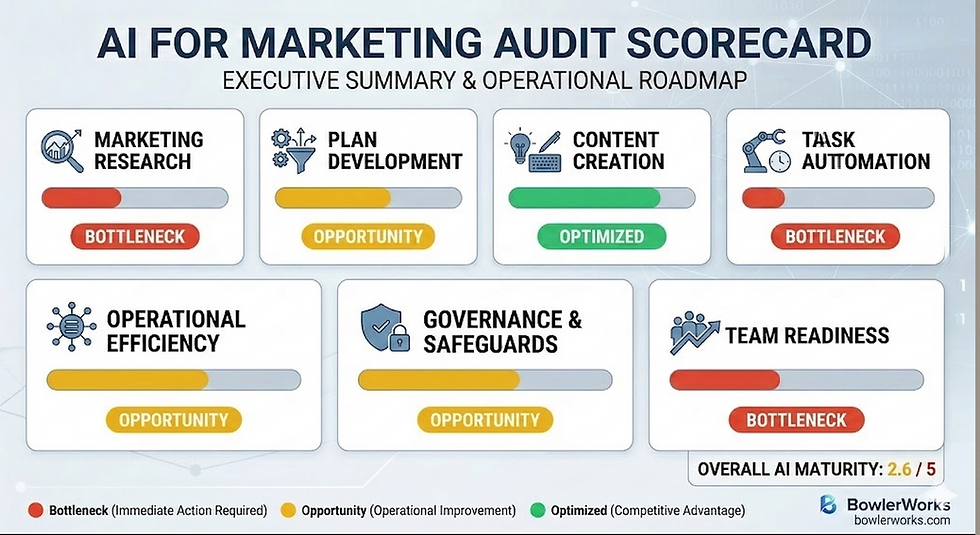
At a high level, an effective AI Marketing Audit looks across five foundational areas of modern marketing:
1. Marketing Research
How insights are gathered today and where AI can accelerate discovery and trend identification.
2. Plan Development
How research is translated into strategy and how AI can support smarter, more adaptive planning.
3. Content Creation
How content is produced, governed, and scaled responsibly with AI support.
4. Task Automation
Where repetitive work can be streamlined to free up time for higher-value efforts.
5. Operational Efficiency
How well tools, data, and workflows function together as a system.
Together, these areas provide a clear picture of where AI can deliver real impact rather than isolated experimentation.
Why This Approach Works
The biggest mistake organizations make with AI is starting with technology instead of clarity.
An AI Marketing Audit creates:
A realistic view of current capabilities
A roadmap for where AI adds the most value
Guardrails for responsible use
Alignment between strategy, execution, and measurement
Instead of guessing where to invest, teams gain a structured path forward.
Instead of scattered experiments, they build sustainable improvement.
AI Is Not the Strategy. It Supports the Strategy.
One of the most important outcomes of an AI Marketing Audit is perspective.
AI does not replace good marketing fundamentals. It enhances them.
Strong research becomes faster and deeper
Planning becomes more informed.
Content becomes easier to scale responsibly.
Workflows become more efficient.
Operations become more aligned.
When guided by experience and strategy, AI becomes a powerful enabler of better marketing.
In the next few articles, I’ll walk through each of the five components of an AI Marketing Audit in more detail, including real-world examples of how organizations are already applying AI to improve performance.
If you’re exploring how AI fits into your marketing organization, this framework provides a practical place to start. Feel free to leave any comments, as always.


Comments