
AI in Content Creation: Scaling Output Quickly and Consistenly


In the previous post, we explored how AI can support smarter marketing plan development by helping teams make more informed decisions based on real performance insights.
Now let’s turn to one of the areas generating the most excitement and confusion around AI in marketing: content creation.
Because while AI has made it easier than ever to produce content quickly, speed alone doesn’t equal effectiveness or necessarily, brand consistency.
The Content Pressure Most Teams Face
Modern marketing teams are expected to produce a constant stream of content across multiple channels:
Social media posts
Email campaigns
Blog articles and landing pages
Ad creative and messaging variations
Website updates
All while maintaining consistency in brand voice, messaging, and quality.
Traditionally, this work has required heavy manual effort, which makes scaling difficult and often leads to bottlenecks, burnout, or inconsistent output. This is where AI can be incredibly helpful, when applied thoughtfully.
Where AI Adds Real Value in Content Creation
AI works best in content creation as a support system, not a replacement for human creativity and strategy.
When used responsibly, AI can help teams:
Generate ideas and outlines faster
Organize content calendars by channel
Create variations for testing and personalization
Maintain consistency across formats and channels
Reduce time spent on repetitive production tasks
Instead of starting from a blank page every time, teams can focus more energy on strategy, storytelling, and optimization.
The result is greater speed without sacrificing quality.
A Real World Example
I worked with a brand that was struggling to keep up with content demands across email, social, and website updates. Their messaging was strong, but production time was slowing campaign launches and creating inconsistencies between channels.
By introducing AI assisted drafting aligned to brand guidelines and messaging frameworks, the team was able to:
Produce first drafts faster
Maintain consistent tone and positioning
Create multiple content variations for testing
Reduce production time significantly
What previously took days now took hours, without losing brand control or quality.
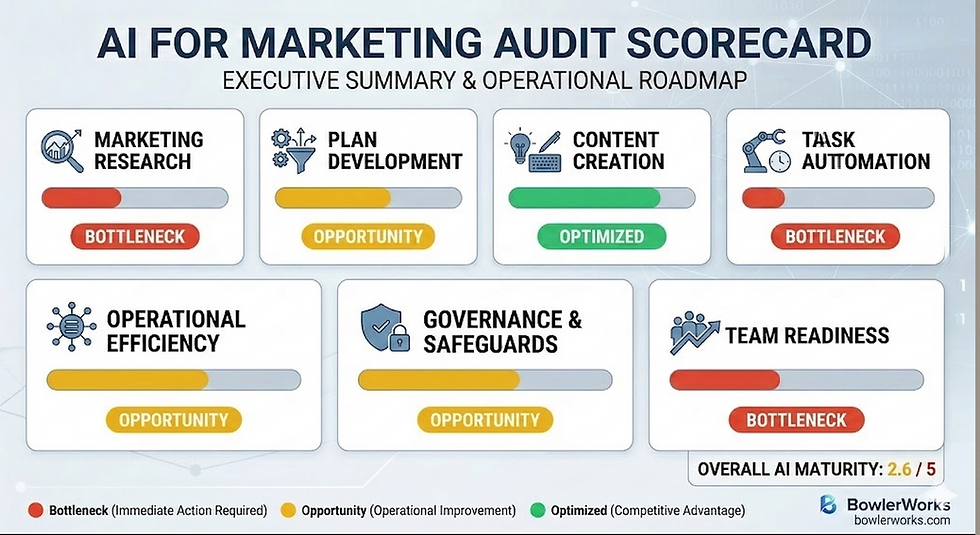
What an AI Marketing Audit Evaluates in Content Creation
From an audit perspective, content creation isn’t just about whether AI is being used. It’s about how responsibly and effectively it’s integrated into workflows.
An AI Marketing Audit typically examines:
How content is planned and prioritized
Where production bottlenecks exist
How brand voice and standards are maintained
Where personalization opportunities exist
Which tasks can be responsibly accelerated with AI
The goal is not maximum automation. The goal is consistent, high quality output that scales.
The Biggest Mistake to Avoid
One of the most common mistakes teams make with AI content tools is treating them as publishing engines.
This almost always leads to:
Generic messaging
Inconsistent tone
Reduced credibility
AI should support creativity, not replace it. Human oversight remains essential for:
Strategy
Storytelling
Brand voice
Accuracy
When that balance is maintained, AI becomes a powerful production accelerator.
Why This Matters for Marketing Performance
Content fuels nearly every part of digital marketing.
Better content leads to:
Stronger engagement
Clearer messaging
Higher conversion rates
More effective personalization
When AI helps teams produce better content more consistently, the impact compounds across campaigns and channels.
What’s Next
In the next post, we’ll look at how AI supports Task Automation, and where marketing teams are seeing some of the fastest efficiency gains by streamlining repetitive workflows.
If you’re exploring how AI fits into your marketing organization, content creation is one of the areas where value becomes visible very quickly, when done responsibly. Feel free to share your thoughts in the comments section.


Comments