
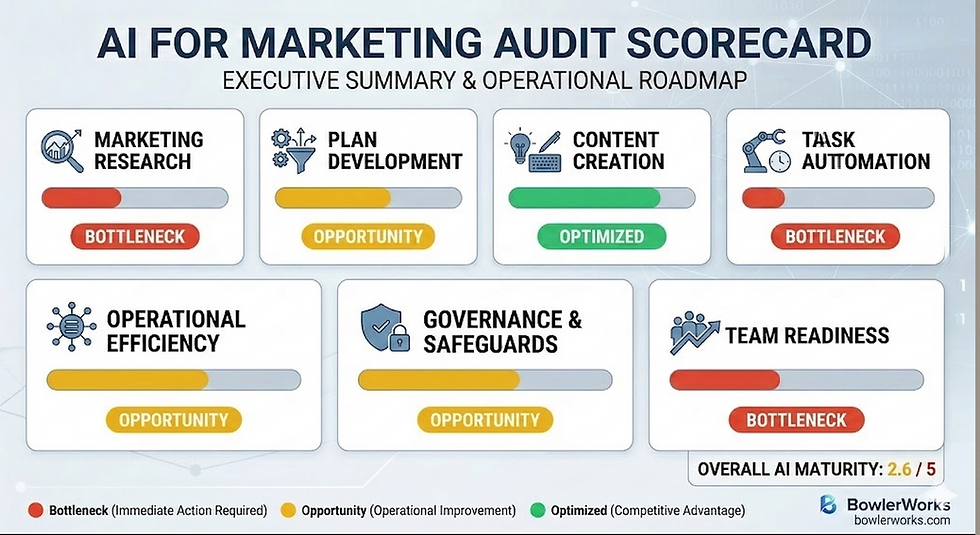
AI Marketing Audit: Task Automation


Where AI Delivers Immediate Impact in Marketing.
So far in this series, we’ve explored how AI can enhance marketing research, support smarter planning, and accelerate content creation.
Now let’s look at one of the areas where most marketing teams feel the impact fastest: task automation.
Because while strategy and creativity drive growth, much of a marketer’s day is still spent on repetitive, time-consuming operational work.
The Reality of Day-to-Day Marketing Work
Beyond campaigns and content, marketing teams are responsible for a constant stream of tasks, including:
Setting up campaigns across platforms
Pulling and formatting performance reports
Scheduling and publishing content
Managing lists, segments, and follow-ups
Coordinating between tools and systems
These activities are essential, but they often consume a disproportionate amount of time.
Over time, this leads to slower execution, more manual errors, and less focus on high-value strategic work.
Where AI and Automation Make the Biggest Difference
AI supported automation is most effective when applied to predictable, repeatable processes.
When implemented thoughtfully, it can:
Streamline data collection and reporting
Reduce manual campaign setup steps
Coordinate workflows across tools
Trigger follow-ups and segmentation automatically
Maintain consistency in execution
The goal is not to remove human oversight. The goal is to eliminate unnecessary busywork.
A Real World Example
I worked with a marketing team that spent several hours each week manually pulling performance data from multiple ad platforms and analytics tools to build leadership reports.
Not only was this time consuming, it also introduced frequent errors and delays. By implementing AI assisted reporting workflows that automatically collected, normalized, and visualized data, the team reduced reporting time from hours to minutes.
More importantly, they gained faster access to insights, which improved decision making and campaign optimization. The work didn’t disappear. It just became smarter and faster.
What an AI Marketing Audit Evaluates in Task Automation
From an audit perspective, task automation focuses on identifying where time is being lost and where workflows can be streamlined responsibly.
Key areas typically include:
Manual reporting and data aggregation
Campaign setup and optimization steps
Content scheduling and publishing
Lead routing and segmentation
Handoffs between marketing tools and systems
The objective isn’t full automation of everything. It’s targeted efficiency that frees teams to focus on what matters most.
Why Automation Creates Immediate ROI
Unlike some strategic initiatives that take time to show impact, automation often delivers value quickly.
Teams commonly see:
Faster execution cycles
Reduced operational errors
Lower workload strain
Improved consistency
More time for strategic work
In many cases, automation alone can justify early investment in AI capabilities.
What’s Next
In the next article, we’ll explore how AI improves Operational Efficiency, and how organizations can use AI to make marketing function better as a connected system rather than a collection of disconnected tools and processes.
If you’re beginning your AI journey, task automation is often one of the fastest places to see real benefits. As always, feel free to comment.


fly88 nói thật lúc mới mở lên mình cũng hơi lăn tăn, vì mấy trang kiểu này hay bày biện lung tung nhìn là nản, nên mình chỉ định lướt vài phút cho biết thôi. Ai ngờ bố cục lại khá “dễ thở”, nhìn cái là hiểu mình đang ở mục nào, khỏi phải mò mẫm nhiều; menu đặt chỗ dễ thấy nên chuyển qua lại cũng nhanh, không phải bấm vòng vòng. Mình không có vào sâu hay thử gì cả. Chỉ ngồi xem cách họ trình bày cho người mới, và thấy mấy khối thông tin dạng bảng cột sắp xếp gọn, tiêu đề với số liệu tách ra rõ ràng nên mắt đỡ phải căng. Nói chung…
rr88 tối qua mình rảnh tay lúc chờ đồ ăn nên bấm vào nghía thử cho biết, kiểu lướt nhanh xem có gì khó chịu không. Trang mở lên nhìn khá gọn, chữ nghĩa vừa đủ đọc, mấy khối nội dung tách ra rõ nên kéo xuống vẫn theo kịp (mình dễ mất kiên nhẫn lắm). Mình thử bấm qua vài mục linh tinh thì thấy thao tác chuyển trang ổn, không kiểu bắt nhảy qua lại quá nhiều như mấy site hay làm màu. Có cái mình thích là họ để phần thông tin nguồn gốc pháp lý thành một mục riêng trên web, nhìn phát thấy ngay chứ không phải đi mò ở chân trang. Nói chung mình…
AI Business Plan Generator showed up in a convo about getting past the “blank page” stage, so I poked around for a minute. I wasn’t expecting much, but the page makes its point fast: if you rely on generic AI chat, you end up in that endless prompting loop where the draft gets huge and still feels kinda generic. I liked that it doesn’t pretend you’re a consultant — it’s more like “here’s the structure so you’re not stitching market pricing execution together by hand.” The whole layout is super scannable too, not a wall of text. The comparisons are stacked in a simple vertical flow, with clear headings and chunky sections that are easy to skim.
Mình trước giờ xem mấy dự đoán chủ yếu để giải trí, chứ xổ số thì vẫn là chuyện may rủi nên không dám đặt niềm tin tuyệt đối. Dù vậy, khi biết chọn lọc thì cũng đỡ bị ngợp, nhất là lúc có quá nhiều kiểu luận nghe cái nào cũng có lý. Có thời gian mình thử ghi chép vài kỳ theo soi cầu mb xem có “hợp vía” không, kết quả thì cũng bấp bênh thôi, trúng trật xen kẽ. Nhưng nhờ vậy mình tập được thói quen giữ kỳ vọng vừa phải, không bị cuốn theo cảm xúc mỗi lần gần ra số. Thường mình chỉ xem vài cặp thấy ổn rồi dừng, coi như thư…