
Using AI to Build Smarter and Faster Marketing Plans


In the previous article, we looked at how AI is transforming marketing research by helping teams surface deeper insights in a fraction of the time. But insight alone doesn’t drive results. What matters is how those insights are translated into clear, actionable marketing plans.
That’s where the second major impact of AI comes into play: plan development.
The Traditional Challenge of Marketing Planning
Most marketing plans are built through a familiar process. Teams review research, analyze performance data, debate channel priorities, define messaging frameworks, and map out campaigns using spreadsheets, presentations, and historical benchmarks.
While this approach works, it has some real limitations:
Planning cycles can be slow and labor intensive
Assumptions often replace real performance signals
Scenario testing is difficult and time consuming
Plans tend to be static once finalized
In fast moving digital environments, this can leave teams reacting instead of adapting.
Where AI Improves the Planning Process
AI doesn’t replace strategic thinking or human judgment in planning. What it does well is connect insights, data, and outcomes more quickly and more clearly.
With AI assisted support, teams can:
Analyze past campaign performance across channels
Identify which audiences and messages convert best
Model different budget and channel scenarios
Surface correlations that aren’t immediately obvious
Test assumptions before committing resources
Instead of building plans based largely on historical averages or gut instinct, teams can ground strategy in real performance patterns. The result is not just faster planning.
It’s smarter planning.
A Real World Example
I worked with a marketing team that was preparing its quarterly campaign roadmap using the same planning approach it had followed for years. Historically, budgets were split fairly evenly across search, paid social, and email based on tradition more than performance.
By applying AI assisted analysis to historical data, the team uncovered a clear pattern: certain customer segments consistently converted at much higher rates through paid social, while others responded far better to search.
Armed with that insight, they restructured their channel mix and messaging approach.
Without increasing overall spend, they saw stronger engagement, higher conversion rates, and a more efficient use of budget.
What once required weeks of analysis happened in hours.
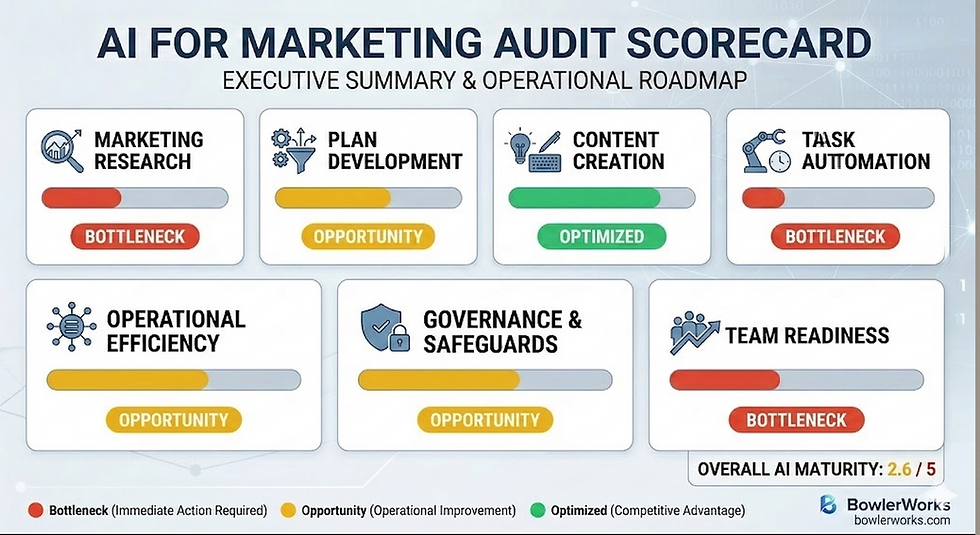
What an AI Marketing Audit Evaluates in Planning
When it comes to plan development, an AI Marketing Audit focuses on how strategies are currently created and where AI can support better decisions.
Key areas typically include:
How research insights are translated into positioning and messaging
How channel mix and budget allocation are determined
How content is planned and prioritized
How performance expectations are modeled
The goal is not to automate planning. It’s to make planning more informed, adaptable, and grounded in data.
Why Smarter Planning Matters
Marketing environments change quickly.
Audience behavior shifts.
Channels evolve.
Costs fluctuate.
Competitors adjust strategies.
AI supported planning helps teams:
Adapt faster to performance signals
Reduce reliance on assumptions
Allocate resources more effectively
Improve ROI across campaigns
Strong research sets the foundation. Smart planning turns insight into impact.
What’s Next
In the next article, we’ll explore how AI fits into Content Creation, and how teams are using AI to scale production responsibly without sacrificing brand voice or quality.
If you’re exploring how AI can improve your marketing strategy, planning is one of the areas where value becomes visible very quickly. Feel free to share any insights around AI and plan development in the comments below.


hi88 bữa thấy bạn bè nhắc hoài nên mình cũng ghé thử cho biết, chủ yếu xem giao diện thôi chứ không có thời gian đọc kỹ. Vừa vào là thấy bố cục chia theo từng mảng nhìn khá thoáng, kéo xuống không bị rối mắt kiểu dồn chữ một cục. Mình để ý cái menu đặt ngay chỗ dễ thấy nên chuyển qua lại mấy mục nhanh, đỡ phải tìm vòng vòng. Mấy phần thông tin họ trình bày dạng bảng cột nên liếc một cái là nắm được ý chính, không bị ngợp. Nói chung cảm giác làm gọn gàng, hợp kiểu người mới vào xem lướt. Đi một vòng xong mình thấy cách họ gom nội dung…
Mình thường canh sát giờ quay để ngó qua soi cầu XSMB với soi cầu MB cho đỡ sốt ruột, kiểu cập nhật nhanh xem tình hình thế nào. Trước khi chốt gì thì mình hay xem thống kê lô gan, lô xiên, rồi đối chiếu lại mấy kỳ trước để cảm nhận nhịp ra số. Giữa lúc đó mình có liếc thêm dự đoán xsmb như nguồn tham khảo phụ thôi, chứ không bao giờ coi là chắc ăn. Trong nhóm mình nhiều người còn thích quay thử XSMB, Rồng Bạch Kim, kèm bảng lịch sử để soi theo tần suất thực tế cho kỹ hơn. Cá nhân mình thấy xổ số miền Bắc không hẳn chỉ dựa may…
Mình mua vé số chủ yếu để thư giãn, kiểu xem cho vui chứ không đặt nặng chuyện đổi đời. Trước đây nghe người ta bàn về “cầu” này “cầu” kia mình cũng không tin lắm, nhưng lâu lâu ngồi theo dõi lại thấy có vài dạng lặp lại nên cũng tò mò thử ghi chép. Mỗi lần đọc mấy bài nhận định, mình thường note nhanh vài ý rồi đợi ra kết quả để đối chiếu, coi thử có phải mình đang tự ám thị hay không. Khi cần thêm dữ liệu so sánh thì mình hay mở https://soicauxsmb.io/so-ket-qua-30-ngay.html xem lại cho tiện. Có hôm trúng được chút thì vui, nhưng cũng nhiều lần trật hoàn toàn nên mình…